Episode 21: From Farm Gate to Firewall
Why Every Farmer, Grower and Land Manager Should Give an Hour to This Podcast
Ask most farmers what keeps them up at night and you’ll hear about the weather, input costs, or low market prices. Increasingly, though, there’s a quieter risk creeping onto the list: what happens if the technology running your farm stops doing what you tell it to?
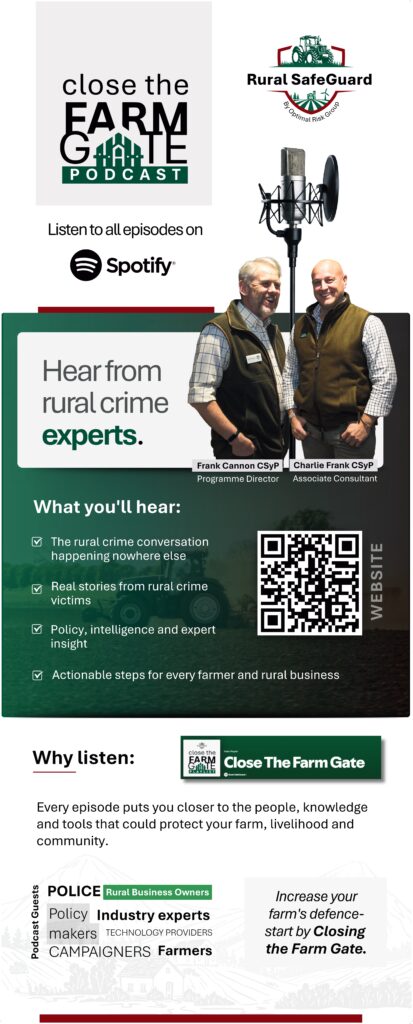
In the latest episode of our podcast, I sit down with Matt Morgan, a cybersecurity professional who’s spent nearly twenty years protecting critical infrastructure — and who also happens to help run the IT on his in-laws’ Somerset dairy farm. Between us, we cover a lot of ground: robotic milking parlours, self-driving tractors, grain store sensors, and the very real people trying to exploit them. If you manage a farm, a grower business, or any land-based operation that now relies on connected equipment, this conversation was made for you.
Here’s why it’s worth your time, and what you’ll walk away with.
1. Your farm is more “connected” than you think
Most of us picture farm technology as the office laptop that handles invoices and livestock passports. But modern farms run on something bigger: operational technology, or OT — the sensors, robots, and automated systems that physically control your business. Cows wearing health sensors, robotic parlours that milk, weigh and feed automatically, tractors that steer themselves, and grain stores that regulate their own temperature are all examples. The distinction matters, because when this equipment is compromised, the impact isn’t just data loss — it’s a physical one. A hacked HVAC system in a poultry shed, for instance, could raise the temperature overnight and kill the entire flock before anyone notices. A jammed signal on an autonomous machine in a field could let someone strip it for parts while it sits there, disabled and unable to call for help. This isn’t a hypothetical. It’s happening, and it’s the kind of consequence that goes well beyond an inconvenient IT outage — think lost yield, dead livestock, ruined reputations, and in the worst cases, a business that simply can’t recover.
2. The cost of doing nothing
That’s really the heart of this episode. Farms are adopting powerful, efficient technology faster than they’re adopting the habits needed to protect it. Matt shares real examples of robotic parlours installed with data cables run bare across sheds, no protection from rodents let alone criminals, feeding into a computer gathering dust in an attic. If that cable is cut or that machine is compromised, there’s often no fallback plan — because the old, slower system it replaced was quietly decommissioned. And it isn’t only about equipment failure. Ransomware attacks, where criminals lock your systems and demand payment, are increasingly common, and many now come with a second threat: if you don’t pay, they’ll sell your data — supplier details, financial records, personal information — to the highest bidder. Doing nothing isn’t a neutral choice. It’s a bet that it won’t happen to you.
3. The practical advice you’ll actually use
What makes this episode useful rather than just alarming is the amount of straightforward, actionable advice Matt offers. A few highlights: keep your farm office computer network completely separate from the network running your operational equipment, so a problem in one doesn’t automatically become a problem in the other. Ask hard questions before you buy new kit — can you set a strong password, can it be changed, has the equipment been security tested — and be prepared to walk away if the answer is no. Keep a manual, low-tech fallback for your most critical processes, whether that’s a traditional way of checking grain temperature or simply more hands on deck if the robots go down. And don’t overlook cyber insurance — many providers now expect to see evidence of basic protections before they’ll pay out.
Central to the conversation is Cyber Essentials, a government-backed scheme that gives any farm business, large or small, a straightforward way to check its own defences. The standard version is a self-assessed checklist covering the basics — backups, passwords, multi-factor authentication — and costs around £320 plus VAT. For higher-risk operations, Cyber Essentials Plus adds an independent assessor and even a penetration test, essentially someone trying to break in on purpose so you can fix the gaps before a criminal finds them. It isn’t a guarantee against attack, but it’s a genuine baseline, and it can strengthen your position with suppliers, insurers, and customers alike.
4. The takeaway
Nobody expects a farmer to become a cybersecurity expert. But just as you’d have a vet, an agronomist, and a mechanic on speed dial, this episode makes the case for adding one more contact to that list. Technology has transformed what a modern farm can achieve — but only if it keeps running. Give this episode a listen, have the conversation with your family or your team afterwards, and take the first small step. It might be the most valuable hour you spend on the business all month.