Frank Cannon CSyP, Programme Director for Rural SafeGuard™ a rural crime reduction initiative.
Current Challenges in British Farming
A recent survey has revealed troubling figures for British agriculture: a third of farmers are either making a loss or barely breaking even, with only a small proportion achieving a profit margin of 10% or more. This is highlighted in the inaugural UK Farmdex[2] Report by McCain Foods, which surveyed 200 farmers in July and found widespread pessimism within the industry.
Over half of those surveyed are contemplating leaving farming entirely.
The industry has been hit hard by a prolonged drought and extreme heat, severely impacting crop yields, particularly for arable farmers. These problems are compounded by sharp reductions in subsidies following Brexit and the introduction of inheritance tax for farms valued at £1 million or more. The report notes that nearly a third of these high-value farms are also only breaking even or running at a loss. This situation raises serious concerns about the future of British farming and the government’s ability to achieve food security—ensuring enough safe, nutritious, and affordable food for the domestic market and boosting exports.
Expert Perspectives: Charlotte Smith
Charlotte Smith[3], presenter of the BBC Country File and Farming Today programmes, highlights three main issues affecting farmers: the weather, global commodity prices, and changes to government support. England recently saw its second worst cereal harvest on record, with vegetable yields also badly affected due to insufficient water. These conditions have cost some farms hundreds of thousands of pounds. Global commodity prices remain low despite poor UK harvests because of strong yields elsewhere, preventing UK farmers from benefitting from higher prices. In addition, significant changes in government support—especially the inheritance tax—have created anxiety and uncertainty, impacting succession planning within farming families. Hopes in the farming community that the government might revisit the inheritance tax policy were recently dashed when the farming minister confirmed there would be no changes in the upcoming budget.
Impact of Subsidy Changes
Subsidy arrangements have also changed dramatically. While Scotland, Wales, and Northern Ireland are still receiving EU-style payments as they develop their own systems, England has moved more quickly to a system where public money is only given for public goods. The direct farmer payment has been almost completely phased out, a process accelerated in the last budget. Previously, subsidy payments could amount to over half a farmer’s income, but this support has now virtually disappeared in England, severely affecting farm incomes. Environmental Land Management Schemes (ELMS) were introduced as a replacement, but the scheme is currently closed to new applicants due to a lack of funds.
Voices from the Farming Community
- Ollie Harrison[4], an arable farmer near Liverpool, expresses deep frustration and exhaustion after two years of extreme weather—ranging from a wet harvest with no sunlight to a year of intense heat resulting in poor crop quality. He points out that subsidies are essential to buffer farmers against unpredictable weather, and without them, many will leave the industry rather than risk their family homes. Diversification has helped his farm survive, but he warns that the withdrawal of environmental payments will soon leave many farmers with no support at all, threatening the nation’s self-sufficiency in food. Harrison criticises the government for not understanding or valuing agriculture, and for perpetuating the myth of farmers as wealthy landowners, when in reality farms are assets for future generations, not sources of personal wealth.
- Duncan McAllister[5], a beef farmer on the Mull of Kintyre and vice president of the National Farmers Union in Scotland, agrees that weather is a constant concern for farmers. Confidence and profitability are closely linked, and currently, a lack of profits is preventing reinvestment in farms across the UK. While beef prices have recently improved due to a global shortage, the sector has suffered from decades of poor trading conditions, and a few good years are not enough to secure the industry’s future.
- Philip, a cereal farmer from West Yorkshire, reports that the price for crops such as wheat is the same as it was thirty years ago, while costs for machinery, bread, and fuel have risen dramatically. The need to comply with strict quality and safety standards for domestic sales drives up costs, while imported products are not always held to the same standard, creating an uneven playing field.
Policy and the Future
Some contributors, such as John from North Yorkshire, argue that the government must make a political decision to support farming and food production, but in an environmentally responsible manner. He observes a strong demand for advisory services to help farmers access new environmental schemes but criticises the current suspension of new applications to the Sustainable Farming Incentive. The design of new subsidy schemes in England is robust but must be implemented and funded properly.
Rural Life and Changing Realities
Brenda Hocroft from North Manchester reflects on her farming upbringing, noting that although farming has always been hard, it has become much tougher recently. Farms have become smaller and less viable as sole sources of income, leading many to diversify into other work—ranging from contract work and groundworks to installing solar panels and even running restaurants. Despite the idyllic nature of her childhood, she doubts if modern farmers can sustain the same lifestyle, given the financial and practical challenges they now face.
END OF RADIO SHOW SUMMARY
So why is Rural SafeGuard™ Sharing this Public Facing Conversation
As discussed in Jeremy’s show, farmers face significant stress already, so we aim to help them reduce rural crime that further harms their success.
Reducing Rural Crime
There will be few UK farmers who haven’t been affected by rural crime in some form. The sliding scale is huge, from petty theft and vandalism to livestock rustling and industrial-scale fly tipping by organised gangs.
Optimal Risk Group[6] have created this rural crime reduction programme to suggest solutions for how agricultural businesses across the nation can be safer and secure.
The company offers practical advice in risk management and security for businesses of all sizes with extensive technical expertise, comprehensive market knowledge, and highly specialised training courses to keep businesses across multiple industrial sectors safe, including agriculture.
A pioneer in the security and risk management industry with a national presence spanning over 25 years, Optimal Risk Group is looking to tackle rural crime head on with their structured national programme, Rural SafeGuard™.
Described as a knowledge sharing programme to raise awareness about and reduce rural crime, Rural SafeGuard™ equips farmers and landowners with the skills, knowledge and training needed to safeguard their people, property, and machines from organised and opportunistic crime.
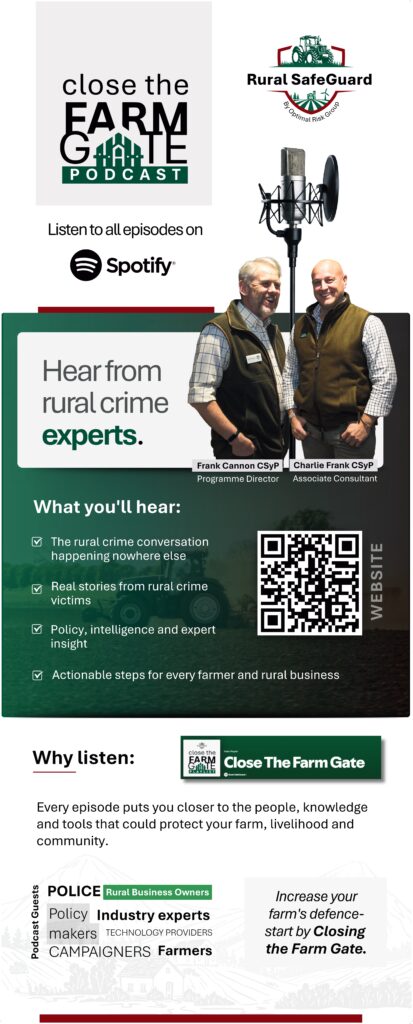
For over 40 years, Senior Consultant Frank Cannon[7] has been providing guidance and advice as a security specialist, and one of five Chartered Security Professionals[8] in the Rural SafeGuard™ programme. He and his team are bringing their expertise to the Uk agricultural sector.
“We are disrupters in the agricultural crime reduction area, as hitherto, our farmers and landowners have expected the police to look after their businesses,” says Frank. “We’re attending this year’s Midlands Machinery Show because it’s a great way to meet and talk to the farmers who are concerned about the safety of their business, and to show the farming community that we have the expertise and advice for them to address the rural crime challenges that they face.”
Optimal Risk is looking to build a public-private partnership to bridge the capability gap between police and rural communities and closely collaborate with police rural crime teams while using proven risk management solutions adapted from other sectors.
“For those farmers who own, operate, or lease out agricultural machines, our Rural SafeGuard™ programme introduces a commercially available certification pathway that recognises secure farms and estates, reassuring owners, deterring offenders, and unlocking potential security advantages.”
Having spent all year researching the attack methods of the organised crime groups and developing effective solutions, Frank sees 2026 as a great opportunity to shine a light on the crime related issues that rural communities face, such as the mismatch between levels of rural crime and the policing and business resources assigned to address it. He is looking forward to sharing the affordable and proportionate solutions that Rural SafeGuard™ can bring to farmers.
“With the support of our partners, the Rural SafeGuard™ programme is a leading example of how we work together to help British farmers develop their risk management skills to withstand crime across our countryside.
“We don’t just help farmers react to crime; we help them to reduce the opportunity for it to happen in the first place.”
You can reach out to frank by e-mailing him on: frank.cannon@ruralsafeguard.com
[1] https://www.bbc.co.uk/sounds/play/m002l831
[2] https://www.mccain.com/information-centre/news/uk-farmdex-report-reveals-crisis-in-farming-51-of-farmers-considering-leaving-the-industry-but-signs-of-hope-remain/
[3] https://www.bbc.co.uk/programmes/profiles/3Nnfpwp9CtjJj6sz5TBrZqc/charlotte-smith
[4] https://www.youtube.com/channel/UC2K8QmHQq3LLphq5XwbxHhA
[5] https://www.thescottishfarmer.co.uk/news/24914044.find-nfus-vp-candidate-duncan-macalister/
[6] https://optimalrisk.com/
[7] https://www.linkedin.com/in/frank-cannon-csyp-cpp/?originalSubdomain=uk
[8] https://www.charteredsecurityprofessional.org/