Modern farming already recognises a simple truth: specialist risks require specialist advice. This is why agronomists are engaged to protect crop health and productivity, and veterinarians are relied upon to safeguard animal welfare and biosecurity. Rural crime presents a risk of equal significance—one that threatens not only assets, but operational continuity, safety, confidence, and long‑term viability.
Engaging a rural crime reduction consultant follows the same proven logic farmers already trust in crop and livestock management.
Avoidance is Best: The Same “Pre‑Emergence” Thinking Farmers Already Use
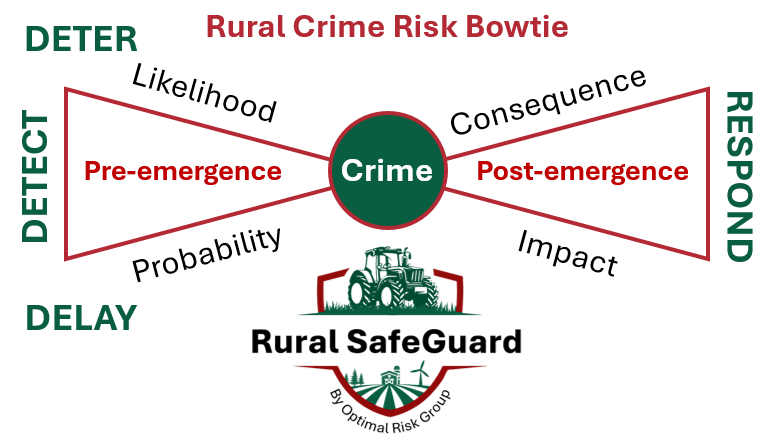
Agronomists assess soil health, nutrient balance, and pest occurrence before crops emerge, reducing the likelihood of yield loss. Vets implement immunisation and biosecurity measures before disease outbreaks occur, reducing the probability of illness spreading through a herd.
A rural crime consultant applies this same pre‑emergence discipline to crime risk.
Through structured farm‑security assessments, crime trend analysis, and vulnerability mapping, a crime reduction consultant identifies weak points before they are exploited—whether that is machinery storage, fuel security, livestock movement, access routes, or patterns of activity on the farm. This directly mirrors how agronomists and vets reduce likelihood rather than reacting only after damage has been done.
Just as farmers would not wait for crop failure or disease before seeking advice, relying solely on reactive crime response leaves the business exposed to avoidable loss.
Reducing Consequences: Professional Response when Incidents do Occur
Even with the best reduction measures, incidents still happen. Farmers understand this clearly in animal health: when illness or injury occurs, vets provide rapid diagnosis, treatment, and recovery planning to limit harm and restore productivity.
Crime reduction consultants play an equivalent post‑incident role.
They support victims, coordinate effective responses, and conduct root‑cause analysis to avoid repeat incidents. By strengthening detection and response measures —aligned with the deter, detect, delay, and respond protective security principles— they reduce the consequence and impact of crime on the farm business, staff wellbeing, and community confidence.
This structured response ensures crime is treated as a managed risk, not an unavoidable cost of rural life.
Crime is a Business Risk—Not Just a Policing Issue
Agronomists are not replacing farmers; they are enhancing decision‑making with specialist insight. Vets do not remove responsibility for animal care; they strengthen it with expertise.
In the same way, a crime reduction consultant does not replace police involvement. Instead, they translate crime reduction into practical, proportionate, and affordable actions that fit the realities of a working farm. Their role is to protect productivity, assets, and people—just as other rural specialists already do.
A Logical Extension of Professional Farm Management
Farmers already invest in expertise to protect:
- Crop yield and soil performance (agronomists)
- Animal health and welfare (veterinarians)
Engaging a crime reduction consultant simply completes the picture by protecting:
| A farmer’s home and family. | Farm infrastructure and equipment. |
| Staff safety & wellbeing. | Farm machinery, materials, and livestock. |
| Agri-business resilience. | Farm operations and business continuity. |
And ultimately, helps the farmer to deliver the national food security supply chain.
When viewed through the same risk‑management lens, crime reduction consultancy is not an optional extra—it is a logical and responsible extension of modern, professional farming practice.
Note to editors:
Rural Safeguard is UK’s first, commercially available, national programme designed to reduce rural crime before it happens. We introduced farmers, growers, land manager, and rural communities to the security sector and share best practise currently on offer to other industrial sectors. This helps to protect livelihoods, strengthen food security, a makes the countryside a safer place for all.
Website: https://ruralsafeguard.com/
E-mail: frank.cannon@ruralsafeguard.com