Farm assurance schemes are built on a clear principle: identified risks must be actively managed using competent advice, proportionate controls, and documented review. Farmers already demonstrate this approach through the routine engagement of safety advisors, agronomists, and veterinarians to safeguard people, protect crop performance, animal welfare, biosecurity, and compliance.
Rural crime represents a material risk to farm businesses that aligns directly with these same assurance principles and therefore requires the same professional, structured approach.
Risk Identification and Assessment
Agronomists assess soil condition, nutrient balance, and pest pressure to identify risks to crop establishment and yield. Vets assess herd health, disease vectors, and welfare indicators to identify risks to livestock performance and compliance.
A rural crime reduction consultant fulfils an equivalent risk identification role for crime and security.
Through structured farm‑security assessments, crime trend analysis, and vulnerability mapping, a crime reduction consultant identifies threats (types of criminals) and crime risks (likelihood and impact of crime) to property, infrastructure, livestock, staff safety, and operational continuity before incidents occur. This mirrors the safety assurance requirement to identify hazards proactively rather than relying on reactive action.
Avoidance Controls (Risk Likelihood Reduction)
Farm assurance places strong emphasis on controls that reduce the risk:
- Agronomists advise on pre‑emergence nutrition, rotation, and pest management to reduce the likelihood of crop failure.
- Vets implement vaccination programmes, biosecurity protocols, and herd‑health plans to reduce the likelihood of disease outbreaks.
- Safety consultants suggest mitigations to reduce health and safety hazards before the injury occurs.
Crime reduction consultancy applies the same reduction, pre‑emergence control logic to rural crime risk.
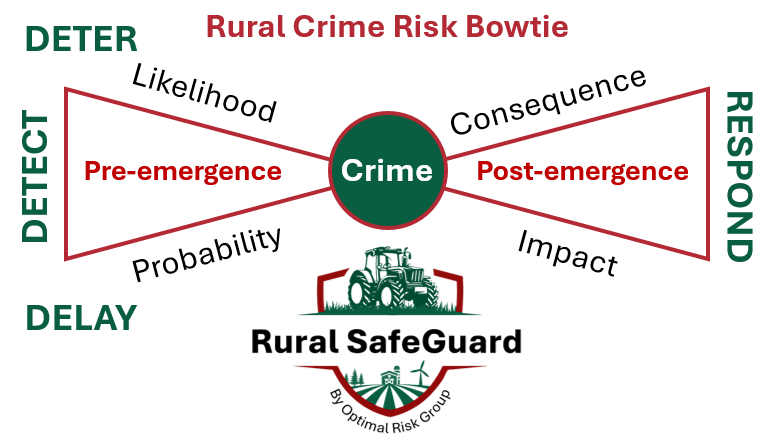
A crime reduction consultant advises on proportionate and affordable measures to deter, detect and delay criminals —such as farm layout, access control, asset protection, and behavioural practices—designed to reduce the probability of criminal activity affecting the farmyard. This demonstrates that crime risk is being actively managed in line with assurance expectations.
Monitor, Detect, and Evolve
Farm assurance requires evidence of ongoing monitoring:
- Crops are inspected for emerging pest or disease pressure.
- Livestock are routinely observed for early signs of illness or welfare concerns.
- Farmyards and operating procedures are frequently reviewed to identify hazards dangerous to health and wellbeing.
Crime reduction consultants support equivalent monitoring and detection measures to identify defensive gaps that a criminal will exploit. These controls ensure that suspicious activity, emerging vulnerabilities, or changing crime patterns are identified early, allowing corrective action before losses escalate. This demonstrates continual risk awareness that helps evolve farm defences rather than static cookie-cut compliance.
Incident Management and Corrective Action (Consequence Reduction)
Assurance frameworks recognise that not all incidents can be prevented and require clear incident response and corrective action processes:
- Vets provide rapid diagnosis, treatment, and recovery planning following illness or injury.
- Agronomists advise remedial action following crop damage or disease outbreaks.
- Accident investigators recommend safety precautions to prevent repeat events.
Crime reduction consultants provide an equivalent post‑incident management function to identify improvement opportunities to reduce the likelihood of recurrence.
They support victims, assist with incident management, and conduct structured root‑cause analysis to identify why controls failed and what improvements are required. This ensures that incidents lead to documented learning, corrective action, and reduced likelihood of recurrence—core assurance expectations.
Continuous Improvement and Business Resilience
Farm assurance is not solely about compliance; it is about continuous improvement, resilience, and sustainability. The goal is to pass on the farm in a better shape than you received it.
Engaging a rural crime reduction consultant demonstrates that the farm treats crime as:
- A managed business risk.
- Subject to professional oversight.
- Integrated into wider health, welfare, and safety systems.
This approach protects not only physical assets but also staff wellbeing, operational continuity, and confidence—key indicators of a resilient, professionally managed farm business.
Crime Risk Management as an Assurance Function
Farmers already demonstrate assurance compliance by investing in specialist advice to protect:
- Crop health and yield (agronomists).
- Animal health, welfare, and biosecurity (veterinarians).
- Staff safety, health, and wellbeing (HSE advisors).
Engaging a rural crime reduction consultant completes this framework by creating affordable solutions to protect:
| A farmer’s home and family. | Farm infrastructure and equipment. |
| Staff safety & wellbeing. | Farm machinery, materials, and livestock. |
| Agri-business resilience. | Farm operations and business continuity. |
When assessed against farm assurance principles—risk identification, control that reduce, hazard awareness, incident response, and continuous improvement—crime reduction consultancy is not an optional addition. It is a logical, proportionate, and assurance‑aligned extension of modern farm management.
How valuable would it be to include the following crime risk assurance declaration in your agricultural business prospectus:
“ This farm manages rural crime as a foreseeable business risk using a planned, predictive, affordable, and proportionate approach, supported by competent specialist advice and integrated into our wider health, welfare, safety, and continuous improvement systems. We advocate operational excellence.”
Word count: 812.
Note to editors:
Rural Safeguard is UK’s first, commercially available, national programme designed to reduce rural crime before it happens. We introduced farmers, growers, land manager, and rural communities to the security sector and share best practise currently on offer to other industrial sectors. This helps to protect livelihoods, strengthen food security, a makes the countryside a safer place for all.
Website: https://ruralsafeguard.com/
E-mail: frank.cannon@ruralsafeguard.com