Bottomline Up Front
NFU Mutual’s Rural Crime Report 2026 deserves genuine praise for its transparency and commitment to exposing the devastating impact of rural crime. However, a headline 6% decrease in estimated costs to £41.6 million should be treated with significant caution. This figure reflects only what one insurer pays out — not the true scale of criminality blighting Britain’s farms, fields, and communities. With 13 ANPR cameras deployed across 246,500 miles of British roads, and a delivery model that asks private policyholders to fund public policing, it is time for Parliament to ask harder questions. Are we investing wisely, or simply doing the same thing over and again — and expecting a different outcome?
The Report That Deserves to Be Read — and Challenged
NFU Mutual is to be sincerely congratulated for publishing its Rural Crime Report 2026. For more than two decades, the organisation has championed rural communities when many in Westminster have not. Its willingness to put figures in the public domain, to fund the National Rural Crime Unit (NRCU), and to support the UK’s first dedicated livestock theft officer reflects a genuine and admirable corporate conscience. That commitment, articulated powerfully by Chairman Jim McLaren — who speaks of over twenty years of advocacy, direct investment in law enforcement, and support for legislative change to reduce the “devastating impact” of rural crime on farmers, their families, and the wider rural community — deserves recognition at the highest levels of Government.
And yet, with respect, recognition is not enough. Data without scrutiny is not accountability. A falling number is not necessarily good news.
The 6% Decrease: Caution Required
Parliament should be cautious about celebrating the reported 6% decrease in estimated rural crime costs, from £44.3 million to £41.6 million. This figure is derived from NFU Mutual’s own claims data — which, however robust, represents only one provider’s slice of the agricultural insurance market. NFU Mutual, despite its dominant position in farm insurance, does not cover every farm in Britain. Cornish Mutual, Howden Rural, and a range of other specialist providers also underwrite agricultural risk.
Here is the critical question that MPs must ask: could a reduction in claims payments reflect not a reduction in crime, but a reduction in NFU Mutual’s market share? If the insurer’s proportion of the rural insurance market has contracted — even marginally — then claims payments would fall arithmetically, regardless of whether a single criminal has been deterred. A 6% fall in the estimated cost of rural crime, calculated solely by one insurer’s internal data, may tell us more about market dynamics than it does about criminal behaviour.
Until all major agricultural insurers are invited to pool their claims data, any headline figure presented to Parliament will remain, at best, an informed estimate and, at worst, a dangerously misleading one.
Thirteen Cameras. 246,500 Miles of Road.
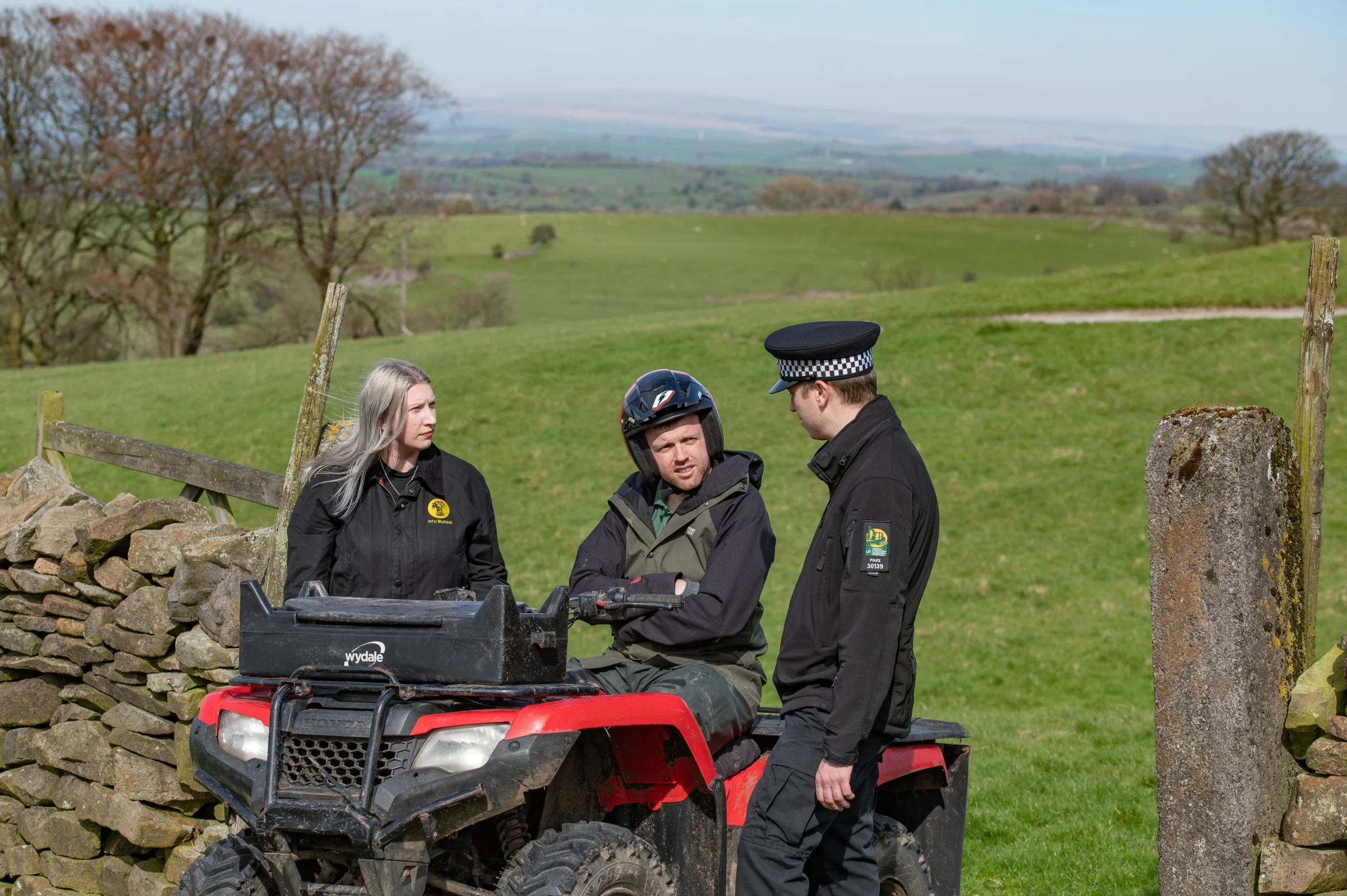
In 2025, NFU Mutual invested nearly £550,000 in rural crime fighting initiatives. This included continued major funding of the National Rural Crime Unit and — strikingly — working with local police forces to install 13 Automatic Number Plate Recognition (ANPR) cameras strategically placed in rural locations across England and Wales.
Thirteen cameras. The Department for Transport’s 2024 road length statistics confirm that Great Britain has approximately 246,500 miles of road — of which the vast majority are minor rural roads and unclassified lanes. To place 13 cameras across this network is not a deterrent strategy. It is, to borrow the language of the farmyard, a plaster on a severed leg caught in a bailing machine. The wound is catastrophic; the dressing is cosmetic.
This is not a criticism of NFU Mutual’s intentions, which are evidently sincere. It is a criticism of the structural inadequacy of the approach. Thirteen cameras cannot provide meaningful coverage of the rural road network, cannot build a credible intelligence picture, and cannot — on their own — shift the risk calculation for organised criminal gangs who travel hundreds of miles to steal quad bikes, tractors, livestock, and fuel.
A Hidden Tax on Policyholders?
Jim McLaren’s commitment to “investing in law enforcement, funding crime-fighting tools, and supporting legislative changes” raises a question that Parliament should examine directly: is this arrangement appropriate?
NFU Mutual is a mutual insurer. Its surplus belongs, ultimately, to its policyholders — the very farmers and rural residents whose properties are being targeted. When that surplus is deployed to fund a specialist police unit — the NRCU — and to purchase ANPR infrastructure for police forces to operate, one must ask whether policyholders are being asked to pay, through their premiums, for a public service that the State has declined to fund adequately. Is this a commercial business filling the gap left by under-resourced policing? Is it, in effect, a hidden tax — levied on rural communities through their insurance premiums — to subsidise public law enforcement?
There is a parallel here with the counter-terrorism world that demands Parliamentary attention. The National Counter Terrorism Security Office (NaCTSO) has, for years, leveraged the knowledge, reach, and commercial networks of the private security sector to deliver crime reduction outcomes that public bodies alone could not achieve. The model works because it draws on private sector agility, commercial expertise, and — crucially — independent innovation. The rural crime reduction world has not yet made that leap. The private security sector, with its specialist capabilities in surveillance, intelligence analysis, physical security, and community engagement, remains largely untapped. If Parliament is serious about rural crime, it should be exploring how a NaCTSO-style model — one that genuinely partners with private security professionals rather than simply congratulating one insurer to fund a police unit — could transform outcomes for rural communities.
To continue investing in the same delivery model, year after year, and hope for a different result, is — as the philosopher’s maxim warns — the very definition of madness.
Scotland, Northern Ireland, and the Policing White Paper
The crime statistics in the 2026 report reveal something that should concern MPs considerably: whilst England and Wales show modest movements in rural crime figures, Scotland and Northern Ireland are experiencing double-digit percentage increases. This is not a footnote; it is a flare.
The Government’s policing White Paper, published in January 2026 and subtitled From Local to National: A New Model for Policing, proposes the most radical restructuring of police forces in two centuries. The creation of a National Police Service, designed to tackle complex and serious crime, risks — if not carefully designed — leaving rural policing further behind. The history of police reform in this country is littered with examples of specialist local knowledge being sacrificed on the altar of efficiency and centralisation. As super-national forces take shape in Scotland and Northern Ireland, the double-digit rises in rural crime in those jurisdictions suggest that rural crime is already being treated as secondary to urban priorities. Parliament must ensure that any restructuring explicitly protects — rather than further erodes — the specialist rural policing capability that communities depend upon.
The Data Gap: An Invitation to Competitors
If NFU Mutual is truly committed to evidence-based advocacy — and its track record suggests it is — then the most powerful step it could take would be to extend an invitation to its competitors. Howden Rural, Intact Insurance, Aviva, Cornish Mutual, Zurich UK (via Rural Insurance Group MGA), AXA UK and every other provider underwriting agricultural business should be brought to the table to share anonymised claims data. A collaborative dataset, compiled under appropriate governance arrangements, would give Parliament, policing bodies, and policymakers an accurate, representative picture of the financial cost of rural crime — not a single-insurer snapshot.
This is not about competitive disadvantage. It is about the integrity of the evidence base. And it is about ensuring that when the rural crime community makes the case to Government for investment, it does so with the full weight of the sector behind it.
The Emotional Cost and the Education Gap
NFU Mutual deserves genuine credit for giving voice to the emotional and psychological toll of rural crime. The statistics are stark, but it is the human stories — the farmer who no longer sleeps soundly, the family who has lost irreplaceable livestock, the community whose sense of safety has been shattered — that should move legislators to act. Rural crime is not merely a financial inconvenience; it is a sustained assault on the mental health and resilience of a community that feeds the nation.
Yet there is a gap in the response that this report, like its predecessors, does not fully address: education. There is no meaningful rural crime reduction curriculum within agricultural or land management degree programmes. Vocational courses at rural colleges rarely, if ever, include structured modules on security risk assessment, crime prevention through environmental design, or the practicalities of protecting agricultural assets. This is a missed opportunity of considerable proportions. Young farmers, estate managers, and rural business owners are entering the industry without the knowledge to protect themselves or their communities.
Conclusion: The Case for a New Model
NFU Mutual’s Rural Crime Report 2026 is a document that Parliament should read, debate, and act upon. It is produced with care, published with courage, and funded with genuine commitment. But commitment and continuity are not the same thing. The evidence suggests that the current model — one insurer, one police unit, a handful of cameras, and annual reports that measure one company’s claims — is insufficient for the scale of the problem.
Parliament owes rural communities more than annual sympathy. It owes them a structural response: a collaborative data architecture, a genuinely funded rural policing strategy, a private security partnership on the NaCTSO model, and a generation of farmers educated to protect themselves. The definition of madness, it has been said, is doing the same thing over and again and expecting a different result. The rural crime figures — however we measure them — suggest we have been doing precisely that for too long.
Bibliography
- NFU Mutual. Rural Crime Report 2026. NFU Mutual, 2026.
- Rural SafeGuard. Close the Farm Gate Podcast.
- Rural SafeGuard. Free Resources and Toolbox Talks.
- Quote Investigator. “The Definition of Insanity Is Doing the Same Thing Over and Over and Expecting Different Results”. Published 23 March 2017.
- National Counter Terrorism Security Office (NaCTSO). Guidance and Resources. Available at: National Counter Terrorism Security – GOV.UK.
- McLaren, J. Opening Statement. NFU Mutual Rural Crime Report 2026. NFU Mutual, 2026.
- Ordnance Survey / Department for Transport. Road Length Statistics (RDL). Available at: Road Length Statistics (RDL) – GOV.UK.